Brazil
How much does a trip to Rio de Janeiro cost?
Plan €1751 for 7 nights in Rio de Janeiro, return flight from London included, or €824 travelling cheap. On the ground that works out at €167 per person per day in comfort, €47 travelling cheap.
- From
- €47/day
- vs. London
- 73%
- Best month
- May
Your trip to Rio de Janeiro
Set the length, the number of travellers and the comfort level: the figures recompute here.
€1,751
per person, flight included
- on the ground
- €1,169
- flight from London
- €582
- per person per day, on the ground
- €167
In short, where the money goes
- The heaviest line
- Accommodation40 % of the trip
- The strongest lever
- Accommodation€392 less travelling cheap
- Seven nights on the ground
- €1169excluding flights
Accommodation
€462
Food
€399
Transport
€126
Activities
€98
Extras
€84
Over seven nights, accommodation accounts for 40 % of what you spend. The line where travelling cheap changes the bill most is accommodation, a €392 gap. The others are worth discussing, that one decides.
Basis: 24 hotel addresses surveyed for a 15 October 2026 arrival, 8 of twelve months of airfares, surveyed on 23 September 2026. The total excludes flights, insurance, personal shopping and any lodging split between several people.
InstantTripCost estimate
Full 7-night budget breakdown
Per-person estimate including flights from London, split across the six expense categories.
per person · Comfort
| Category | Budget | Comfort | Luxury |
|---|---|---|---|
| Flights | €495 | €582 | €873 |
| Hotel | €70 | €462 | €777 |
| Food | €168 | €399 | €945 |
| Transport | €56 | €126 | €315 |
| Activities | €21 | €98 | €378 |
| Misc | €14 | €84 | €287 |
| 7-night total | €824 | €1751 | €3575 |
Flight from London (annual median).
Unit prices
comfort
Enough to check the total yourself, line by line, at the comfort level you picked.
- €9
- Breakfast
- €16
- Lunch
- €32
- Dinner
- €6
- City ride
- €14
- Site admission
- €167
- A full day
Orders of magnitude derived from our measured ranges, not surveyed venue by venue. Prices vary by neighbourhood and season.
The three tiers
What a budget traveller, a comfort traveller and a premium traveller typically spend.
Budget
€47
per day, approx
- Hotel / night
- €10
- Food / day
- €24
- Transit / day
- €8
- Sights / day
- €3
- Extras / day
- €2
Comfort
€167
per day, approx
- Hotel / night
- €66
- Food / day
- €57
- Transit / day
- €18
- Sights / day
- €14
- Extras / day
- €12
Luxury
€386
per day, approx
- Hotel / night
- €111
- Food / day
- €135
- Transit / day
- €45
- Sights / day
- €54
- Extras / day
- €41
When to go, and what the month changes
Average temperatures and conditions by month in Rio de Janeiro.
Mildest monthMay
Cheapest flightOctober€490
Where to sleep in Rio de Janeiro
Choosing a district
The Zona Sul, squeezed between the Tijuca range and the sea, holds the beaches and most of the hotels on a narrow strip where everything is walkable. Centro is practical by day but empties at night, with no restaurants or nightlife around. Rio is structurally short of cheap rooms: at €10 for a hostel and €66 for a mid-range hotel, the gap is wide enough that booking early genuinely changes the bill.
Copacabana
The city's densest hotel strip, from tired two-stars to well-rated addresses along Avenida Atlântica. That concentration keeps prices competitive, and the beach is at the end of every street.
Ipanema - Leblon
A notch smarter and quieter than Copacabana, with apart-hotels that come with a kitchen, the best-value option for a group. Bracarense, Leblon's classic boteco, pours draft beer at local prices.
Flamengo - Catete - Botafogo
The strip between Guanabara Bay and downtown, where the small, simple, clean hotels cluster. Flamengo Park and its 1.2 million square metres of walkways start at the foot of the buildings.
Santa Teresa - Lapa
On the hill above Lapa, the district of pousadas and guesthouses, served by the Bonde, Brazil's last historic city tram. Below, Lapa holds the street party and the live samba, if you accept the climb home.
The hotels we measured
Accommodation picks by price range.
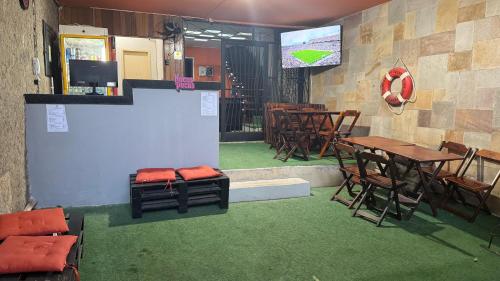
Maracanã Hostel Sport Bar
Hostel, well rated (8.3/10) from 399 reviews.

Vidigal Varandas Hostel
Hostel, decent (7.6/10) from 534 reviews.
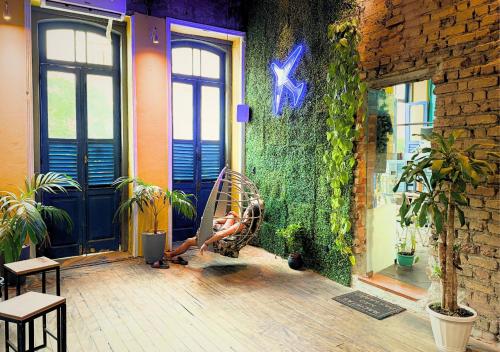
Por el Mundo Hostel
Hostel, decent (7.2/10) from 2,117 reviews.

Saionara Hotel
Hotel, very well rated (8.5/10) from 3,706 reviews.

Ház Jardim Guanabara
Hotel, well rated (8.1/10) from 874 reviews.

ibis Rio de Janeiro Santos Dumont
Hotel, well rated (8.1/10) from 5,249 reviews.

Vila Galé Rio de Janeiro
Hotel, very well rated (8.7/10) from 7,299 reviews.

Windsor Guanabara Hotel
Hotel, very well rated (8.7/10) from 3,341 reviews.
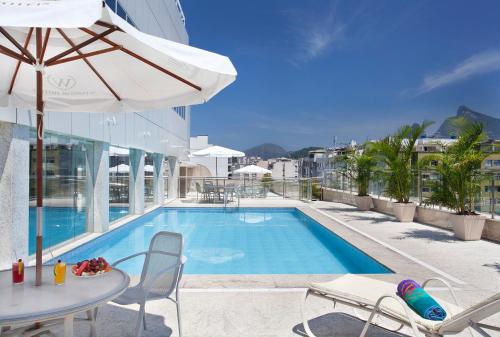
Windsor Florida Hotel
Hotel, very well rated (8.6/10) from 5,830 reviews.
All observed hotels in Rio de Janeiro
24 of 24 surveyed properties shown, the cheapest in each tier. Nightly rate for a 2-night stay arriving 15 October 2026.
| Hotel | Category | Rating | From / night |
|---|---|---|---|
| Imóveis Iemar | Budget | ★ 6.5 | €5 |
| Samba Hostel | Budget | ★ 7.4 | €6 |
| Hostel São Cristovão | Budget | ★ 10 | €7 |
| Vidigal Varandas Hostel | Budget | ★ 7.6 | €8 |
| Hostel by Hotel Galicia | Budget | ★ 5.7 | €8 |
| Casa na Barra da Tijuca | Budget | ★ 10 | €8 |
| Maracanã Hostel Sport Bar | Budget | ★ 8.3 | €9 |
| Por el Mundo Hostel | Budget | ★ 7.2 | €9 |
| Ház Jardim Guanabara | Mid-range | ★ 8.1 | €34 |
| Itajubá Hotel | Mid-range | ★ 7.7 | €38 |
| Hotel Atlântico Rio | Luxury | ★ 6.8 | €42 |
| Hotel Villa Rica | Mid-range | ★ 7.9 | €43 |
| ibis Rio Porto Atlantico | Mid-range | ★ 7.9 | €43 |
| ibis Rio de Janeiro Parque Olimpico | Mid-range | ★ 7.9 | €49 |
| ibis Rio de Janeiro Centro | Mid-range | ★ 7.7 | €51 |
| Saionara Hotel | Mid-range | ★ 8.5 | €59 |
| ibis Rio de Janeiro Santos Dumont | Mid-range | ★ 8.1 | €59 |
| Hotel Atlântico Copacabana | Luxury | ★ 6.9 | €64 |
| Vila Galé Rio de Janeiro | Luxury | ★ 8.7 | €67 |
| Windsor Florida Hotel | Luxury | ★ 8.6 | €73 |
| Windsor Guanabara Hotel | Luxury | ★ 8.7 | €73 |
| Hotel Astoria Copacabana | Luxury | ★ 7.7 | €77 |
| Augusto's Copacabana Hotel | Luxury | ★ 7.7 | €83 |
| Windsor Palace Copacabana | Luxury | ★ 8.4 | €103 |
What food costs in Rio de Janeiro
Concrete benchmarks to set your meal budget, from the morning coffee to dinner.
Rio's budget reflex is called comida a quilo: buffet restaurants where you pay by the weight of your plate, no menu, no table service. You build what you want and control the bill to the gram, roughly €8 to €12 for a generous lunch. The second lever is local snacking: the coxinha, a fried chicken croquette, and sucos, the fresh-pressed juices sold on nearly every corner, work as a light meal for a couple of euros. Feijoada, the black bean and meat stew, is more of a weekend thing and holds you for the day. In the evening, the botequim, the neighborhood bar with ice-cold draft beer and small plates, costs a fraction of a churrascaria rodízio, where you pay a flat rate for all-you-can-eat grilled meat. And most hostels around Ipanema post R$30 to R$50 a night with breakfast included: one fewer meal to fund each day.
What getting around costs in Rio de Janeiro
Transit, distances and the smart moves so you don't pay the tourist tax.
Rio runs an unusual multimodal system, forced by its topography: metro, commuter rail, BRT, buses, ferries and cable cars. One card links nearly all of them, the RioCard Bilhete Único Carioca, which costs the price of a single ride, R$4.70, and discounts any second trip taken within two hours inside the municipality. It is refundable with the remaining balance, but only at a RioCard shop, never at the airport: cash it in before you leave, not on flight day. The metro has just two lines and stops at Ipanema on the Zona Sul side, with air-conditioned but infrequent trains; buses stay the densest way to move around the south of the city. From Galeão, the BRT to Vicente de Carvalho plus the metro costs one ordinary fare, while the air-conditioned express bus along the coast costs several times that. Tourist rides, the Sugarloaf cable car and the Corcovado rack railway, are excluded from the card and paid separately.
What sightseeing costs in Rio de Janeiro
Recommended activities and tours.
Museu Nacional
The National Museum of Brazil (Portuguese: Museu Nacional) is the oldest scientific institution of Brazil. It is located in the city of Rio de Janeiro, where it is installed in the Paço de São Cristóvão (Saint Christopher's Palace), which is inside the Quinta da Boa Vista.
National museum
Museu Nacional de Belas Artes
The Museu Nacional de Belas Artes (MNBA; Portuguese for National Museum of Fine Arts) is a national art museum located in the city of Rio de Janeiro, Brazil. The museum, officially established in 1937 by the initiative of education minister Gustavo Capanema, was inaugurated in 1938 by President Getúlio Vargas.
Art museum
Christ the Redeemer
Christ the Redeemer (Portuguese: Cristo Redentor, standard Brazilian Portuguese: [ˈkɾistu ʁedẽˈtoʁ]) is an Art Deco statue of Jesus in Rio de Janeiro, Brazil, created by French-Polish sculptor Paul Landowski and built by Brazilian engineer Heitor da Silva Costa, in collaboration with French engineer Albert Caquot and Romanian sculptor Gheorghe Leonida who sculpted the face. Constructed between 1922 and 1931, the statue is 30 metres (98 ft) high, excluding its 8-metre (26 ft) pedestal, and faces east.
Monument
Valongo Wharf
The Valongo Wharf (Portuguese: Cais do Valongo) is an old dock located in the port area of Rio de Janeiro, between the current Coelho e Castro and Sacadura Cabral streets. Built in 1811, it was the site of landing and trading of enslaved Africans until 1831, with the blockade of Africa banning the Atlantic slave trade to Brazil (but the Brazilian government continued turning a blind eye to the trade until 1850).
Archaeological site
Brazilian Academy of Letters
The Brazilian Academy of Letters (Portuguese: Academia Brasileira de Letras, ABL; Portuguese pronunciation: [akadeˈmiɐ bɾaziˈlejɾɐ dʒi ˈletɾɐs] ) is a Brazilian literary non-profit society established at the end of the 19th century. The first president, Machado de Assis, declared its foundation on 15 December 1896, with the by-laws being passed on 28 January 1897.
Museum
Candelária Church
The Candelária Church (Portuguese: Igreja da Candelária, pronounced [iˈgɾeʒɐ ðɐ kɐ̃deˈlaɾjɐ]) is an important historical Roman Catholic church in the city of Rio de Janeiro, in southeastern Brazil. It was built and decorated during a long period, from 1775 to the late 19th century.
Church
Quinta da Boa Vista
The Quinta da Boa Vista (English: "Estate of the Good View") is a public park of great historical importance located in the São Cristóvão neighbourhood, in the North zone of the city of Rio de Janeiro, Brazil. The park was part of the gardens of the São Cristóvão Palace, the residence of the King of Portugal and then the Emperors of Brazil in the 19th century and the home of the Zoological Garden of Rio de Janeiro, with over 2000 species of animals.
Park
Old Cathedral of Rio de Janeiro
The Old Cathedral of Rio de Janeiro dedicated to Our Lady of Mount Carmel (full name in Portuguese: Igreja de Nossa Senhora do Monte do Carmo da antiga Sé, lit. 'Church of Our Lady of Mount Carmel of the Ancient See') is an old Carmelite church which served as cathedral (Sé) of Rio de Janeiro from around 1808 until 1976. During the 19th century, it was also used successively as Royal and Imperial Chapel by the Portuguese Royal Family and the Brazilian Imperial Family, respectively.
Church
Flamengo Park
Flamengo Park, also known as Aterro do Flamengo, Eduardo Gomes Park, and Aterro do Brigadeiro Eduardo Gomes, is the largest public park and recreation area within the city of Rio de Janeiro, in eastern Brazil, and the largest urban seaside park in the world. [1] The park is located along Guanabara Bay, in the Flamengo neighborhood of the city, between Downtown Rio and Copacabana.
Park
Parque Lage
Parque Henrique Lage, known as Parque Lage, is a public park in the city of Rio de Janeiro, located in the Jardim Botânico neighborhood at the foot of the Corcovado, on top of which Christ the Redeemer is located. Antonio Martins Lage, who was married to Felicité Clarisse de Labourdonnay, daughter of the Count of Labourdonnay, purchased the property in the early 1830s.
Park
Places referenced on Wikidata. Admission prices vary by season - check each venue's official site.
Paying less in Rio de Janeiro
What moves the needle
What each decision takes off the €1676 total, strongest lever first.
- − €840
Travel cheap rather than mid-range
Hostel or entry-level hotel, local canteens, public transport. Accommodation is where the gap opens up.
- − €334
Stay five nights instead of seven
Two fewer nights also removes two days of meals, transport and sightseeing.
- − €231
Travel as a pair
The room is shared, nothing else is. Travellers themselves name this as the strongest lever.
Differences computed from our own measurements, for a 7-night mid-range stay, excluding flights.
6 tips on the ground
- The beaches of Copacabana, Ipanema, Arpoador and Barra da Tijuca are public and free: the city's main draw costs nothing.
- Walking up Corcovado on the trail from Parque Lage, which is free to enter, skips the rack railway ticket.
- The pay-by-weight lunch buffet, comida a quilo, runs around €8 to €12 for a full plate, far below a churrascaria rodízio.
- Avoid New Year's Eve and Carnaval: over those two periods lodging rates more than triple and many hotels sell only four-night packages paid in advance.
- The RioCard Bilhete Único costs one single fare, R$4.70, discounts a connection taken within two hours, and refunds the remaining balance at a RioCard shop.
- Travel June to August, Rio's dry season: 44 to 49mm of rain a month against over 250mm in January, and outside the southern-summer price peaks.
FAQ
FAQ - Rio de Janeiro
- How much does a week in Rio de Janeiro cost?
- For seven nights, plan roughly €329 per person on a budget (hostel around €10 a night, pay-by-weight buffets, free beaches and parks), and around €1,169 at mid-range comfort with a hotel near €66 a night, excluding flights. Double those figures, or more, if the trip falls during Carnaval or New Year's Eve.
- What's the best month to visit Rio?
- June to August, the southern winter. This is the dry season: 44 to 49mm of rain a month over only seven to eight days, with highs of 25°C, against 253mm and twenty rainy days in January at 30°C. It is the most comfortable window for walking, and it lines up with European summer holidays without hitting the Carnaval and New Year price peaks.
- Is Rio an expensive destination?
- Not on a global scale, yes on a Brazilian one: lodging here is the priciest in the country. On the comparison's cost index, Rio sits clearly below Lisbon or Madrid, but a notch above Buenos Aires and Lima. It is one of the affordable big South American cities without being the cheapest.
- Should you avoid Carnaval on a tight budget?
- Yes, if budget comes first. Over that fortnight and at New Year, lodging prices more than triple and hotels in tourist areas often sell only four-night packages, payable in advance. Worth knowing: the blocos de rua, the neighborhood parades that draw thousands through Centro and the Zona Sul, are free. It is the samba school parade at the Sambadrome that you pay for.
At a glance
Wikidata, Wikipedia and Open-Meteo data
- Population
- 6.7M
- Area
- 1,260 km²
- Elevation
- 31 m
- Language
- Portuguese
- Currency
- R$
- Time zone
- UTC−03:00
- Founded
- 1565
- Avg. July temp.
- 21°
- Avg. Jan. temp.
- 27°
- Rainy days / year
- 169
inhabitants
Real
17° - 25°
24° - 31°
About
Rio de Janeiro in brief
Rio de Janeiro, also known simply as Rio, is the capital of the state of Rio de Janeiro. It is the second-most-populous city in Brazil after São Paulo with a population of 13 million people as of 2025, and the sixth-most-populous city in the Americas.
Source: Wikipedia (CC BY-SA 4.0)
Keep exploring
Similar budget
Destinations at a similar price
Cost index close to Rio de Janeiro.